






Every drawing in this collection begins the same way: a brush loaded with ink meets paper, and a single unbroken line traces a figure, a face, a movement. What you see here is the full range of that practice — from austere black and white works where the line carries everything, to pieces where a wash of colour or a touch of gold shifts the mood entirely. We invite you to take your time with them.
One Line, One Decision
The defining discipline of Michaela's work is the commitment to a single continuous line. There is no underdrawing, no correction, no second pass. The line either captures the essential truth of the subject or it does not. This constraint, far from limiting the work, is what gives it energy. A shoulder rendered in three fluid centimetres of ink carries more weight than a meticulously cross-hatched study, because every millimetre of that line was placed with absolute intention.
Looking at these drawings asks something of the viewer too. The eye is invited to follow the line the way the hand made it — tracing the arc of a neck, the tension in a wrist, the particular way a musician's body bends toward an instrument. Slow down, and the economy of means becomes its own subject.
Black, White and the Space Between
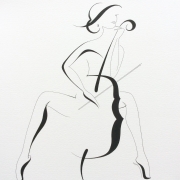
The core of the collection works in black ink on white. These are the purest expressions of the single-line method: no colour to guide the eye, no value modelling to suggest volume. What creates form here is negative space — the white ground that presses back against the line and completes the shape the ink only implies. A face emerges not from what is drawn but from what is left untouched.
The white ink works reverse that logic. Dark grounds throw the line forward; the figure seems to arrive out of shadow rather than stand against light. The effect changes the emotional register of similar subjects considerably — the same gesture reads as quieter, more interior, when drawn in white on dark paper.
Colour as Accent and Atmosphere
Where Michaela introduces colour, she uses it deliberately rather than decoratively. The ink series each have their own character:
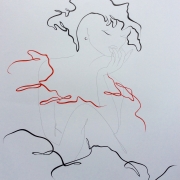
- Red ink brings heat and tension — these works tend toward subjects where energy and physicality matter: sport, movement, figures in action.
- Gold ink lends a ceremonial quality, lending even casual poses a certain weight and stillness.
- The Aquarell watercolours, including the large-format XXL works, let colour expand beyond the line itself — washes bleed and settle independently of the drawn mark, so line and colour become two separate but inseparable layers of information.
None of these series abandons the single-line principle. The ink changes; the commitment to gesture over description does not.
Portraits, Musicians, Figures, Sport
The subjects across the gallery range from portraiture to bodies in motion, with musicians occupying their own substantial strand of the work. Faces are drawn with the same economy as figures: a few carefully placed curves establish a likeness without cataloguing every feature. What registers is character — the set of a jaw, the particular quality of attention in a pair of eyes — rather than anatomical completeness.
The musician drawings are among the most kinetic works here. An instrument and a body in performance create a compound shape, and the single line must move between them without losing either. Watching how the line navigates a cellist's bow arm or a guitarist's left hand reveals the observational intelligence behind what looks, at first glance, like spontaneous mark-making.
The sport and figure series push gesture to its limit. At speed, anatomy simplifies to its most readable essentials: the arc of a throw, the compression of a landing, the coiled potential of a stance. These drawings record not what a body looks like but what it is doing, and the single-line method is exactly the right tool for that ambition.
Browsing the Collection
The thumbnails below are organised by series. Each group has its own visual logic — different ink, different ground, different subject matter — but they share the same underlying sensibility. We add new work regularly as it leaves the studio. Original drawings and selected prints are available; the Contact page is the right place to begin a conversation about acquiring a piece. Works are held in private collections across the Czech Republic and internationally, and originals can also be found in a number of galleries throughout the country.